
5 Skills Every Fresher Needs in 2026 (Beyond Your Degree)
By Skillrank Team · · 5 min read
A degree shows you completed a course. Employers also want proof that you can use current tools, explain your ideas and solve problems you have not seen before. Here are five skills that help you stand out, with a free 30-day plan to build each one.
In short: AI tool literacy, communication, data basics, problem-solving and adaptability are commonly asked for across roles. You can build each with free resources in about 30 days.
Why a Degree Alone Is Not Enough
A degree does not always show that you can use the tools companies use today or handle an unfamiliar problem. Many companies check these skills directly through online assessments and interviews, so what you can do matters alongside what you studied.
The five skills below are useful in most roles, not only in tech.
5 Skills and How to Build Each One in 30 Days
1. AI Tool Literacy
AI assistants are now part of everyday work, from drafting and research to coding. Employers value freshers who can use them well and, just as important, check what they produce. Learn to write clear prompts, verify answers, and know when not to use AI.
Your 30-day plan
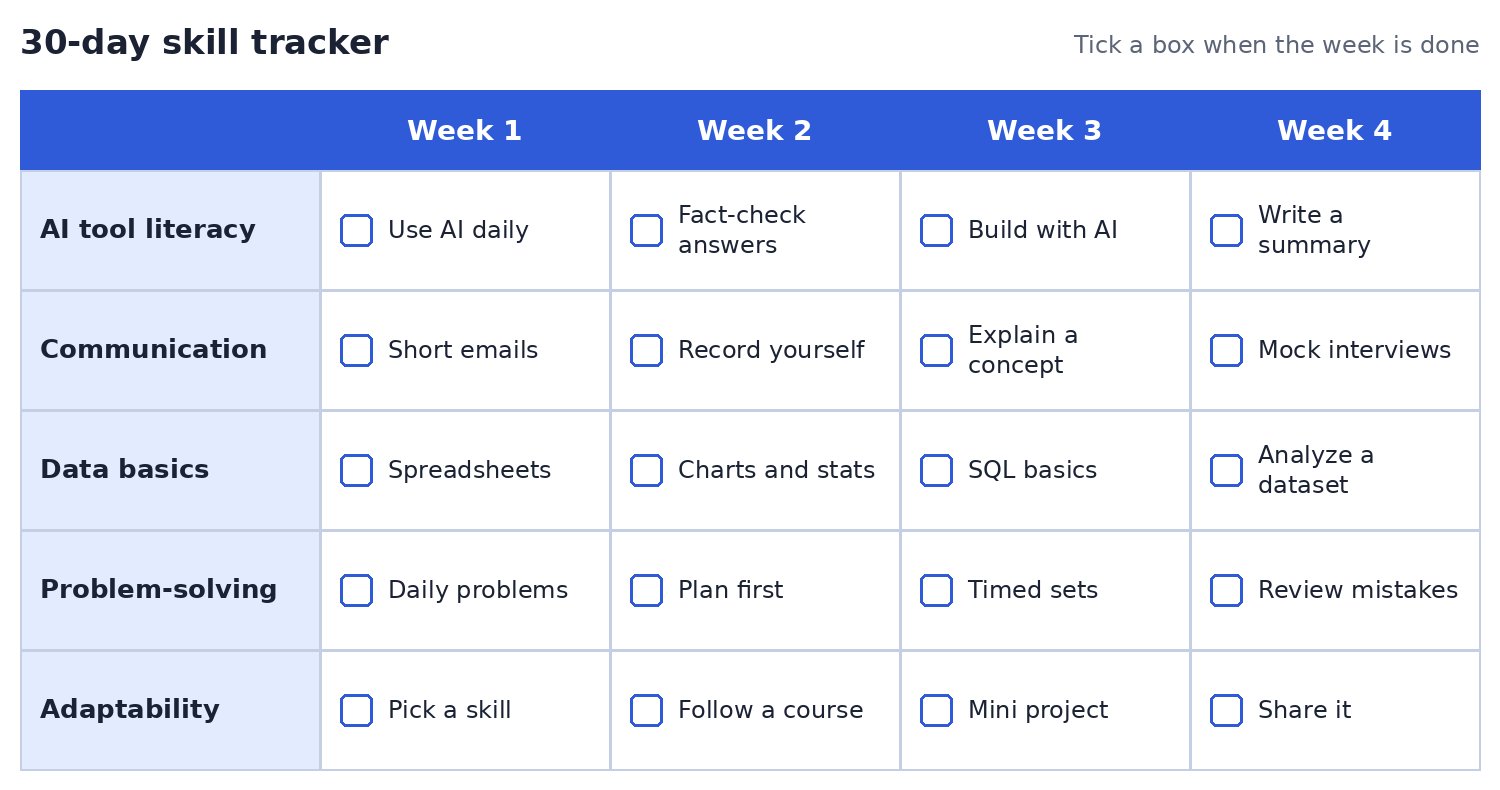
Week 1: Use a free AI assistant daily for one real task. Give it context, an example and the format you want.
Week 2: Ask it to explain topics from your subject, then check each answer against a textbook or official documentation.
Week 3: Build something small with its help, such as a project feature or a report, and note every mistake you had to fix.
Week 4: Write a one-page note on how you used AI and what you would never trust it with.
Never submit AI output that you cannot explain yourself.
2. Communication
Every stage of hiring depends on it: your resume, your emails, your interview answers and your teamwork. Clear and short beats fancy.
Your 30-day plan
Week 1: Write one short email or message a day in five sentences or fewer.
Week 2: Record a two-minute answer to “Tell me about yourself” and watch it back.
Week 3: Explain one concept from your subject to a friend in plain words, without jargon.
Week 4: Do two mock interviews with a friend or senior and ask for specific feedback.
3. Data Basics
Almost every role now involves numbers, whether in a spreadsheet, a dashboard or a simple SQL query. You do not need to be a data scientist, but you should be comfortable reading and summarizing data.
Your 30-day plan
Week 1: Learn spreadsheet basics in Google Sheets: sorting, filtering, formulas and pivot tables.
Week 2: Learn charts and simple statistics such as mean, median and percentages, using the free statistics lessons on Khan Academy.
Week 3: Learn SQL basics (SELECT, WHERE and JOIN) with the free interactive lessons on SQLBolt.
Week 4: Pick a free public dataset from Kaggle and write down five findings.
4. Problem-Solving
Aptitude rounds, coding tests and interviews all check how you break down an unfamiliar problem. This skill improves only with practice.
Your 30-day plan
Week 1: Solve one or two easy problems a day, from aptitude sheets or a free coding platform such as LeetCode, HackerRank or CodeChef.
Week 2: Write your approach in plain steps before you solve each problem.
Week 3: Practice in timed sets of three problems to match real test conditions.
Week 4: Review every mistake and re-solve those problems without looking at the solution.
5. Adaptability and Self-Learning
Tools and requirements change quickly, so employers want people who can pick up something new without hand-holding. Show it by learning a skill and proving it.
Your 30-day plan
Week 1: Pick one new skill related to your target role and set a small, clear goal.
Week 2: Follow one structured free course for 30 to 45 minutes a day, for example on freeCodeCamp or Khan Academy, or read the official documentation.
Week 3: Build or produce one small thing with it.
Week 4: Share it on GitHub or LinkedIn and write down what you learned.
Making It Fit Your Schedule
Do not try all five at once. Pick the two skills where you are weakest, give each about 30 minutes a day, then move on to the next pair. Use this tracker to tick off each week.
Key Takeaways
A degree shows you finished a course. Skills show you can do the job.
The five skills are AI tool literacy, communication, data basics, problem-solving and adaptability.
Each can be built with free resources in about 30 days.
Work on two at a time instead of all five.
Prove each skill with something you can show, such as a project, a post or a test score.
Find Your Skill Gaps First
Take the Employability Test on Skillrank to see which of these skills need the most work, then build your 30-day plan around the results. Try the Employability Test.