
How Company Online Assessments Work: Stages, Sections and Platforms
By Suii · · 4 min read
You applied to a company and an email arrives: “Your online assessment link is below. You have 90 minutes.” What is in this test, and how is it scored?
In short: the online assessment (OA) is the first filter in most fresher hiring. It usually mixes aptitude, verbal, coding and CS fundamentals, runs on a proctored platform, and scores coding by the number of test cases you pass.
Where the OA Fits in the Hiring Process
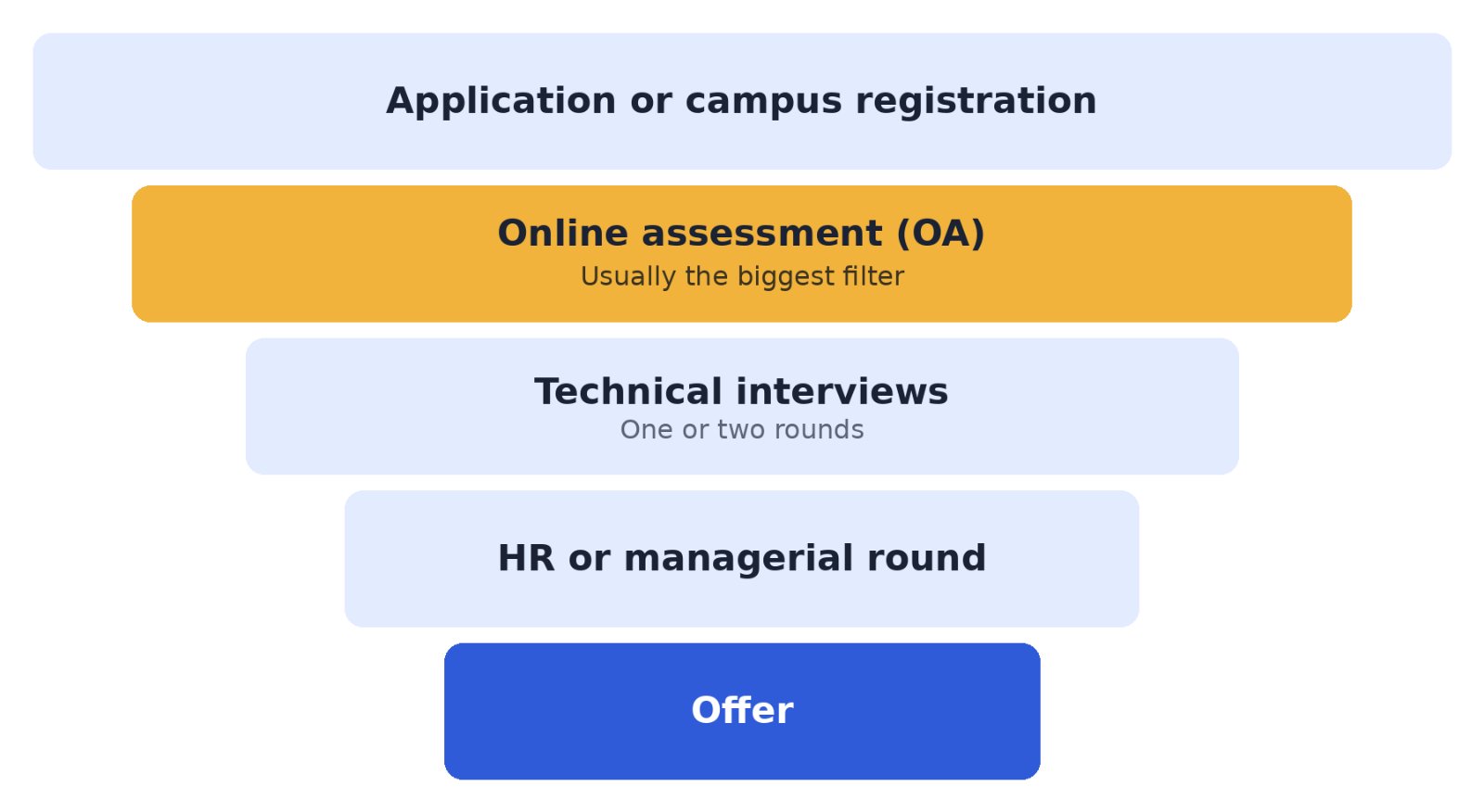
Most fresher hiring goes from application to the OA, then technical interviews, an HR or managerial round, and finally an offer. The order varies by company. Each stage removes candidates, and the OA often removes the most, because it is the only stage that can test thousands of people at once.
What Is Inside an OA
Not every company uses every section. These four are the ones you will meet most often.
Aptitude: percentages, ratios, time and work, data interpretation and logical puzzles. Usually MCQs.
Verbal: grammar, vocabulary and reading comprehension. Usually MCQs.
Coding: arrays, strings, hashing, sorting and other DSA basics. Usually 1 to 3 problems in an online editor.
CS fundamentals: OS, DBMS, SQL, networks and OOP. MCQs, sometimes a SQL query.
Platforms You May See
HackerRank: coding problems and MCQs in one test.
HackerEarth: coding tests and hiring challenges.
Mercer Mettl: proctored tests with aptitude, technical MCQs and coding.
CodeSignal: timed coding tasks that produce a numeric score.
Some companies use their own portal or another provider. Your invitation email names the platform, so read it first.
The Rules of the Test
Time limit: commonly 60 to 120 minutes in total, sometimes with a timer per section. Check if you can move between sections before you start.
Negative marking: some MCQ sections deduct marks for wrong answers, while coding rarely does. If it applies, skip questions you would only be guessing.
Proctoring: commonly a webcam, full-screen mode and tab-switch tracking. Close other apps and stay in the test window.
Cutoffs: an overall cutoff, and sometimes one for each section. Attempt every section, even your weaker one.
What Counts as a Pass in Coding Questions
Each coding problem is checked against a set of test cases. A few are visible samples. The rest are hidden and include large inputs and edge cases. Your score is usually the share of test cases you pass, so partial marks are common.
Take a problem with 10 test cases:
A brute force solution passes 6 of 10 and scores 60%.
An optimized solution passes 10 of 10 and scores 100%.
The brute force solution is correct but too slow on the large hidden inputs, so those cases fail with Time Limit Exceeded. This is why you should submit a working solution first, then improve it.
How Input and Output Work
Most platforms read from standard input and check standard output. Print only the answer, with no extra text, or a correct solution will be marked wrong. Here is a simple problem: read n numbers and print their sum.
Sample input
5
1 2 3 4 5
Sample output
15Python
n = int(input())
nums = list(map(int, input().split()))
print(sum(nums))
C++
#include <iostream>
using namespace std;

int main() {
    int n;
    cin >> n;
    long long sum = 0;   // long long avoids overflow
    for (int i = 0; i < n; i++) {
        int x;
        cin >> x;
        sum += x;
    }
    cout << sum << endl;
    return 0;
}
Java
import java.util.Scanner;

public class Main {
    public static void main(String[] args) {
        Scanner sc = new Scanner(System.in);
        int n = sc.nextInt();
        long sum = 0;   // long avoids overflow
        for (int i = 0; i < n; i++) {
            sum += sc.nextInt();
        }
        System.out.println(sum);
    }
}
Some platforms give you a starter template or a different class name. Use theirs when it is provided.
Checklist Before Your First OA
Read the invitation for the platform, date, duration and allowed languages.
Run the platform's system check, or a practice test if one is offered.
Use a laptop or desktop with a charger, a stable connection and a quiet room.
Practice reading input and printing output in your chosen language.
Take at least one full timed mock test.
Key Takeaways
The OA is usually the first and biggest filter in fresher hiring.
Expect aptitude, verbal, coding and CS fundamentals, though not every company tests all four.
Time limits, negative marking and cutoffs differ by company, so check the invitation.
Coding is scored by test cases passed, so a working brute force still earns marks.
Print only the required output, and watch for overflow and slow code on large inputs.
Find Out Where You Stand Before the Real Test
Take a timed skill test and see which sections need work. Try the Employability Test on Skillrank.