Logical Reasoning and Puzzles Commonly Asked in Placement Tests
Gokul
· 4 min read
Reasoning questions are the part of placement tests where preparation pays off fastest. There is no syllabus to memorise. The questions follow a small set of types, each with a method you can learn in a day. TCS gives about 25 minutes for its reasoning section, Infosys gives 25 minutes for logical reasoning plus 10 for puzzles, and Accenture has a full reasoning section too. This post covers the eight types that repeat most, with a worked example and a fast method for each.
In short: most reasoning questions are solved by drawing the problem (a family tree, a path, a row of seats, a Venn diagram) instead of thinking about it in your head. Learn the eight types below and aim for about a minute per question.
Eight Question Types With Worked Examples
1. Number series
Find the pattern, then the next term. Check in this order: differences, ratios, squares and cubes, then alternating patterns.
2, 6, 12, 20, 30, ?
Differences: 4, 6, 8, 10 -> next difference is 12
Answer: 30 + 12 = 42
2. Coding-decoding
A word is changed by a rule. Work out the rule on the given example, then apply it letter by letter.
If CAT is coded as DBU, what is the code for DOG?
Rule: each letter moves one step forward (C->D, A->B, T->U)
DOG -> EPH
3. Blood relations
Draw a small family tree and work backwards from the end of the statement.
Example: pointing to a man, Riya says, “He is the son of my mother's only brother.” Her mother's brother is her maternal uncle, and his son is her cousin. The man is Riya's cousin.
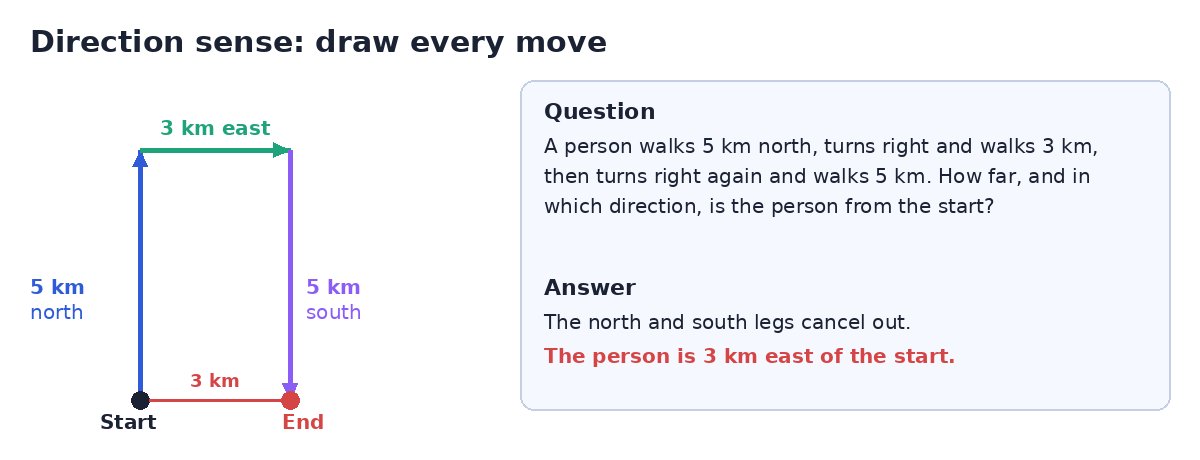
4. Direction sense
Sketch every move on paper. Opposite moves cancel out, so only the leftover distance matters.
5. Seating arrangement
Write the positions as numbered slots and fix the definite clues first.
Five people P, Q, R, S, T sit in a row.
- P is at the left end, T is at the right end.
- R sits immediately left of T.
- Q sits between P and R, but not next to P.
Who sits in the middle?

Positions: 1=P, 5=T, 4=R.
Q is between P and R but not next to P, so Q = 3. S takes 2.
Row: P, S, Q, R, T  ->  Q sits in the middle
6. Syllogisms
Draw Venn diagrams. A conclusion is correct only if it is true in every possible diagram. “Some” statements never turn into “all”.
Statements: All engineers are graduates.
            Some graduates are athletes.
I.  Some engineers are athletes.
II. Some athletes are graduates.

Only II follows. The athletes who are graduates may or may not
include any engineers, so I is not certain.
7. Clocks
For the angle between the hands at H hours and M minutes, use |30H − 5.5M|. If the result is above 180, subtract it from 360.
Angle at 3:30
|30 x 3 - 5.5 x 30| = |90 - 165| = 75 degrees
8. Logic puzzles
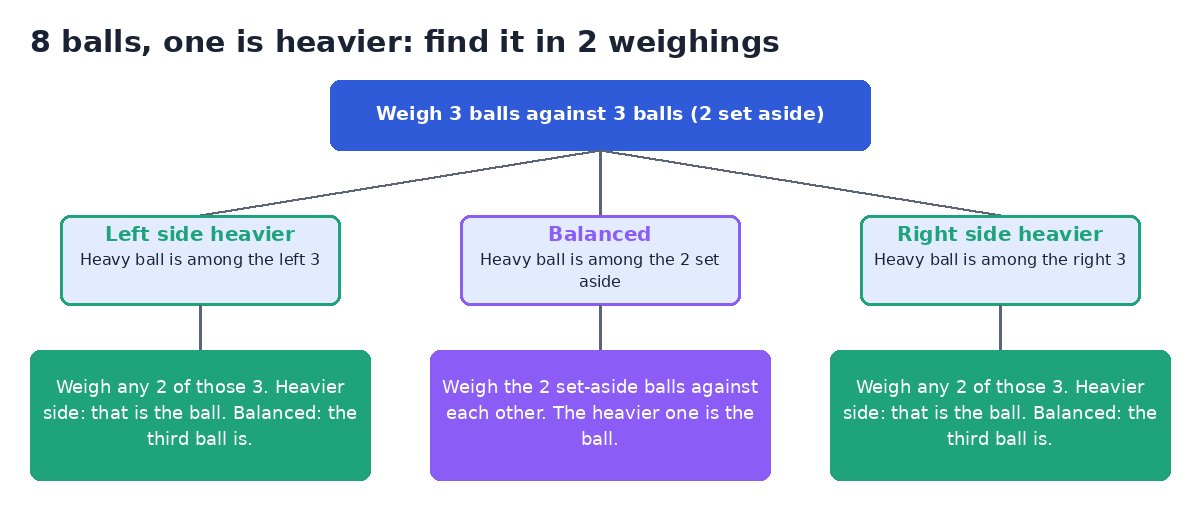
Puzzles reward a systematic split rather than a guess. A classic: you have 8 identical-looking balls and one is heavier. Using a balance scale, how do you find it in two weighings? Split the balls into groups of 3, 3 and 2.
How to Be Faster
Draw first. A 10-second sketch beats 40 seconds of mental juggling.
Learn the question type from the first line. Once you recognise it, the method follows.
Skip and return. If a question is not moving after about a minute and a half, mark it and move on. Most reported formats have no negative marking, so come back and answer every question.
Eliminate options. In number series and coding-decoding, test the answer choices against the rule.
Practice in timed sets. Do 10 questions in 12 minutes, then review every miss.
Common Mistakes to Avoid
Solving seating and relation questions in your head instead of on paper.
Treating “some” as “all” in syllogisms.
Mixing up left and right when the person turns, so always mark the facing direction.
Spending three minutes on one puzzle and losing five easier questions.
Memorising answers instead of the method, which fails when the numbers change.
Key Takeaways
There are about eight repeating question types. Learn one method for each.
Draw the problem: tree, path, slots, Venn diagram.
Number series: differences first. Clocks: |30H − 5.5M|.
Aim for a minute per question and never leave answers blank unless the test penalises wrong answers.
Timed practice matters more than reading more solutions.
Test Your Reasoning Speed
Reasoning improves with timed repetition. Take a timed skill test on Skillrank to see where you stand on speed and accuracy under real assessment conditions.