Your 30-Day Campus Placement Roadmap for Final-Year Students
By Gokul · · 5 min read
With about a month before placement season picks up, it helps to have a plan rather than jumping between a resume rewrite one day and random DSA problems the next. This roadmap breaks the work into four weeks, each with a clear focus, so nothing important gets left for the last minute.
In short: Week 1 is assessing where you stand and planning. Week 2 is fixing your resume and profiles. Week 3 is aptitude and technical practice. Week 4 is mock interviews and actually applying.
The Roadmap at a Glance
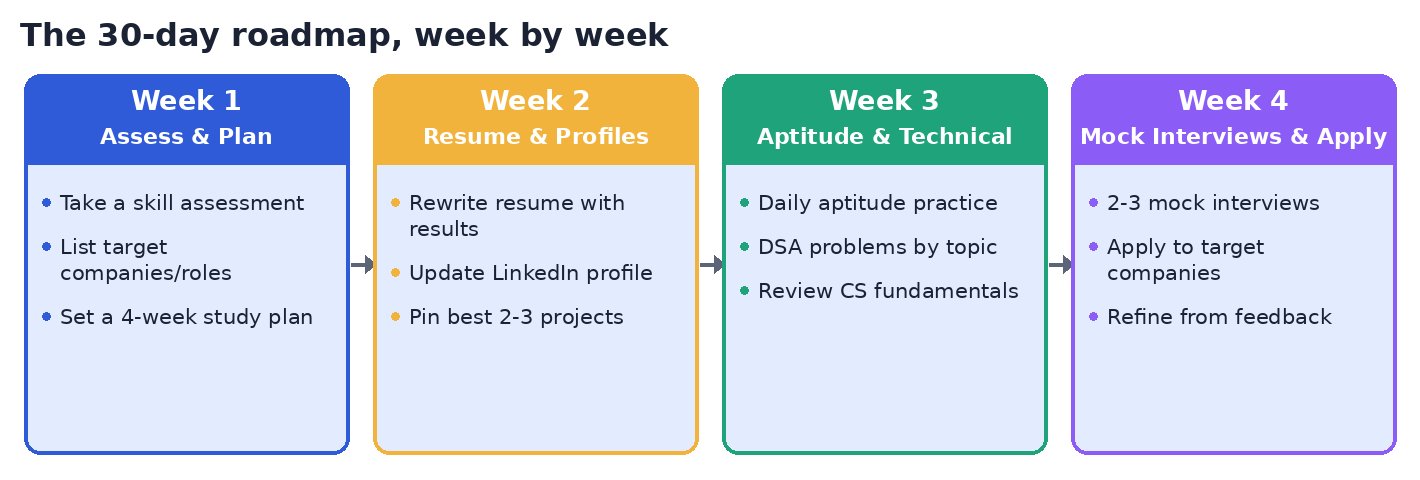
Adjust the exact days to your own schedule and how much time you have around classes. The order matters more than the exact day count: know your gaps before you fix your resume, and fix your resume before you start applying.
Week 1: Assess and Plan
You cannot fix what you have not measured. This week is about getting an honest, specific picture of where you stand, then turning that into a plan for the rest of the month.
Day 1: Take a full skill assessment to see your standing across aptitude, coding and communication, not just how you feel about each area.
Day 2: List the companies, roles, or sectors you are targeting, and note the skills each one typically asks for.
Day 3: Compare your assessment results against those requirements and write down your top 3 to 5 gaps.
Day 4 to 5: Set a realistic week-by-week plan for the remaining 3 weeks, built around those specific gaps rather than a generic checklist.
Day 6 to 7: Start closing your biggest gap immediately if it needs a head start, such as a weak aptitude area or a programming language you barely know.
Skipping this week is the most common reason later weeks feel unfocused. A plan built on your actual gaps is far more useful than one copied from someone else's.
Week 2: Resume and Profiles
Your resume and LinkedIn profile are what get you shortlisted before anyone talks to you, so this week is about making both work harder for you.
Day 8 to 9: Rewrite your resume: replace generic objectives with a two-line summary, and add a measurable result to your strongest bullets.
Day 10: List your 2 to 3 strongest projects properly, each with the problem it solves, the tools used, and a concrete outcome.
Day 11: Update your LinkedIn headline and About section to name the role you want and your key skills, not just your college and year.
Day 12: Pin your best projects to your LinkedIn Featured section and add any certifications you can actually explain.
Day 13: Ask a senior, mentor or career cell staff member to review both your resume and profile, and note their feedback.
Day 14: Apply the feedback and proofread everything once more, checking that every link works.
A resume and profile that clearly show what you can do are worth more at this stage than adding another certificate.
Week 3: Aptitude and Technical Practice
This is the heaviest week, focused on the skills that get directly tested in online assessments and technical interviews.
Day 15 to 16: Practice aptitude daily: percentages, ratios, time and work, and data interpretation, in short, focused sessions rather than long irregular ones.
Day 17 to 19: Work through DSA problems by topic, starting with your weakest areas from Week 1, such as arrays, strings, hashing, trees or graphs.
Day 20: Take one full timed mock coding test to practice time management under real conditions.
Day 21: Review CS fundamentals: OS, DBMS, computer networks and OOP basics, since these commonly appear in MCQ rounds.
Consistency matters more than intensity here. An hour of focused daily practice across this week beats a single long cramming session.
Week 4: Mock Interviews and Applications
The final week is about applying what you have built and getting real feedback before the actual drives begin.
Day 22: Prepare your “tell me about yourself” answer and a few stories about your projects using a simple structure you can adapt to different questions.
Day 23 to 24: Do 2 to 3 mock interviews, technical and HR, with a friend, senior or mentor, and ask for specific, honest feedback.
Day 25: Fix the specific issues that came up in your mock interviews, whether that is clarity, pacing, or a gap in your explanation of a project.
Day 26 to 28: Start applying to your target companies and roles, tailoring your resume summary slightly for each one where it matters.
Day 29 to 30: Keep practicing aptitude and DSA in smaller daily doses, and track which applications you have heard back from.
By the end of this week, you should have an updated resume and profile, a clearer sense of your strengths and weaknesses from real mock feedback, and applications already in motion, not just preparation.
Key Takeaways
Start by assessing your actual gaps, not by copying someone else's study plan.
Fix your resume and LinkedIn profile before you start applying widely.
Give aptitude and technical practice a full week of consistent daily effort.
Use mock interviews to get honest feedback before it counts in a real interview.
Adjust the exact days to your own schedule, but keep the order: assess, fix your materials, practice, then apply.
Share This With Your Placement Cell
This roadmap is meant to be shared, not kept to yourself. Pass it on to your college's placement cell or TPO so your whole batch can follow the same plan, and start Week 1 with an honest skill assessment. Take the Employability Test on Skillrank to find your actual gaps before you plan the rest of the month.