Quantitative Aptitude Shortcuts for Placement Tests
By Gokul · · 5 min read

Aptitude rounds are rarely hard in concept. They are hard because of the clock: you often get under a minute per question, and the long textbook method eats that minute before you even reach the arithmetic. A handful of shortcuts, practiced until they are automatic, is what actually saves time on test day.
In short: break percentages, ratios and time-and-work problems into round numbers you can compute in your head, and always sanity-check your answer against the answer options before moving on.
Why Aptitude Rounds Are a Time Problem, Not a Difficulty Problem
Most placement aptitude sections give you 30 to 45 seconds per question on average, sometimes with a single overall timer and sometimes with a timer per section. The math itself is usually school-level. What separates a good score from an average one is how quickly you get from question to answer without long division or multiplication in the middle.
The shortcuts below work by turning ugly numbers into round ones you already know, such as 10%, 25%, or 50%, and building the answer from there.
Percentages
Most percentage questions come down to one skill: converting a percentage into an easy combination of 10%, 5%, 1%, and multiples of those.
10% of a number is just the number moved one decimal place, so 10% of 480 is 48.
5% is half of 10%, so 5% of 480 is 24.
1% is a hundredth, useful for fine adjustments like finding 34% or 67%.
See the difference this makes on a real question.
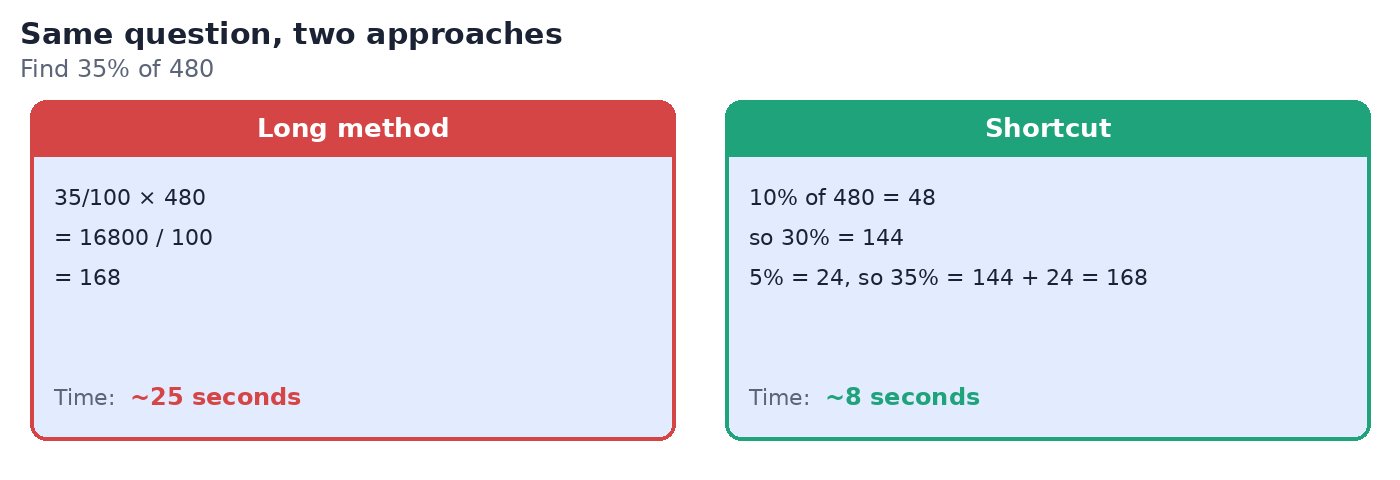
The shortcut is not a different formula, it is the same math done in an order that avoids big multiplications. With practice, this becomes close to instant.
Ratios and Proportions
Ratio questions get slow when you try to solve for a variable using fractions. Instead, treat the ratio as a scaling factor on a convenient unit.
Example: the ratio of boys to girls in a class is 3:5, and there are 24 boys. How many girls are there?
The ratio 3:5 means for every 3 boys, there are 5 girls.
24 boys is 8 times 3, so scale the girls' side by 8 too: 5 × 8 = 40 girls.
This “find the scaling factor first” approach avoids setting up and cross-multiplying a fraction equation, and it is usually faster to do in your head.
Time and Work
Time and work problems become simple once you stop thinking in days and start thinking in “work done per day”.
Example: A can finish a job in 12 days, B can finish it in 8 days. Working together, how long will it take?
A does 1/12 of the work per day, B does 1/8 of the work per day.
Together, they do 1/12 + 1/8 = 2/24 + 3/24 = 5/24 of the work per day.
So the job takes 24/5 = 4.8 days.
The pattern is always the same: convert each person's time into a work-per-day fraction, add the fractions, then flip the total to get the number of days. Once this pattern is automatic, these questions rarely take more than 20 to 30 seconds.
Common Traps in Data Interpretation
Data interpretation (tables, bar charts, pie charts) questions are less about calculation and more about reading carefully under time pressure. These traps catch out candidates who rush.
Wrong base for a percentage: check whether a question asks for a percentage of the whole, or a percentage of a specific category. Mixing these up gives a plausible but wrong answer.
Mismatched units: a chart in “lakhs” combined with a question asking for the answer “in crores”, or a graph in thousands with a question expecting the raw number.
“Approximately” questions: when a question says “approximately”, round early and use the shortcuts above rather than computing an exact figure you do not need.
Reading the wrong row or year: easy to do when scanning quickly. Circle or note the specific row or column before calculating.
A Habit That Saves More Time Than Any Shortcut
Before you calculate, glance at the answer options. If they are far apart (say, 120, 340, 780, 1500), you often only need a rough estimate to pick the right one, which is faster than computing an exact value. If the options are close together, you know you need to be precise, and can budget your time accordingly.
Key Takeaways
Aptitude rounds test speed under a clock more than they test difficult math.
Build percentages from 10%, 5% and 1% instead of using the fraction formula directly.
For ratios, find the scaling factor first instead of solving an equation.
For time and work, always convert to work-per-day and add fractions.
Check answer options before calculating. Spread-out options often only need an estimate.
Practice Under a Real Timer
Reading shortcuts is different from applying them with a countdown running. Take a timed skill test on Skillrank to see how these shortcuts hold up under real test conditions.